





How long should a motorbike tour in the Alps be?
The question of how many kilometres long and how many hours a one-day motorbike tour in the Alps should be is not one that can be answered briefly and in a few words.
This is because there are too many factors that can influence the tour. There is the question of skill, stamina, the type of motorbike and, last but not least, the itinerary for the day trip. For example, do you want to go motorcycling and, in general terms, do some sightseeing?
The decisive factor, however, is which region of the Alps you are travelling in.
Find the answers here.
A rule of thumb – established by us, with many years of experience in various Alpine regions – is that 300 kilometres is the average distance that can be covered in the Alps.
300 kilometres, assuming you are riding on asphalt, equates to around 7 hours, which is also the average riding time. This leaves a good two to three hours for breaks, especially drink breaks, and sightseeing. What factors influence the average driving time in the Alps? First and foremost, geographical factors have an impact on your daily destination. Steep, narrow and winding Alpine passes: • There are regions where the Alps only allow for narrow routes, steep routes and small, tight bends. For example, in the border area between Slovenia, Carinthia (Austria) and Friuli (Italy). Alpine passes such as the Passo del Cason di Lanza, Monte Zoncolan, Paulitsch Pass, Hochobir, Vrsic Pass, Passo Rest and several others have winding, narrow and steep passages. Another example is the south-eastern foothills of the Alps, with Alpine passes sometimes below the 1000-metre mark. Nevertheless, it takes time to drive these routes. Examples include Forcella di Pala Barzana and Passo San Boldo.• In addition to many individual cases in regions that are home to rather extensive Alpine passes, such as Les Martinaux in Valais, the area around Col de Turini in the French Maritime Alps, or Colle d'Oggia, an example of Alpine passes in Liguria, there are also regions in the French Alps worth mentioning. French Alps, examples: Some Alpine passes around the Saint-Maurienne valley are extremely time-consuming. Alpine passes such as Col du Sapey, Col du Chaussy or Col de la Confrérie offer a lot of fun on short stretches, but take a lot of time. Another and final example is a region in the border area in the French Western Alps. Here, the Italian ramps of the border passes Col de la Lombarde and Col d'Agnel are worth mentioning. They are also steep, narrow, winding and therefore time-consuming. A little further south, located entirely in Italy, Piedmont, the Alpine passes Colle Fauniera, Colle d'Esischie and Colle di Sampeyre are worthy representatives of what can be understood in a positive sense as ‘time wasters’. In very few cases does a navigation device take routes of this kind into account. The result is an extremely long day of motorcycling, which can also be exhausting. High density of Alpine passes: In some regions of the Alps, the Alpine passes are so close together that the route is either constantly uphill or downhill. Here, too, we have ‘learned’ in the truest sense of the word over the years that no more than 10 Alpine passes should be planned for an average of 300 kilometres. If narrow, tight and winding Alpine passes are also on the list of planned motorcycle tours, the driving time can quickly extend to 10 hours. Typical examples are the Alpine passes in the Dolomites, regions in the border triangle of Friuli/Carinthia/Slovenia, but also in central Switzerland with Alpine passes such as the Oberalp Pass, St Gotthard Pass, Furka Pass, Grimsel Pass, Oberaar Panoramic Road, Nufenen Pass ... Further concentrated clusters of Alpine passes can be easily identified when planning your tour with our ‘Alpine Pass Atlas’ tour planner.
A rule of thumb – established by us, with many years of experience in the various Alpine regions – is that 300 kilometres is the average distance that can be covered in the Alps.
300 kilometres, assuming you are riding on asphalt, means about 7 hours, which is also the average riding time. This leaves a good two to three hours for breaks, especially drink breaks, and sightseeing.
What factors influence the average riding time in the Alps?
First and foremost, geographical factors have an impact on your daily goal.
Steep, narrow and winding Alpine passes:
• There are regions where the Alps only allow for narrow routes, steep routes and, in addition, only small, tight radii for the bends.
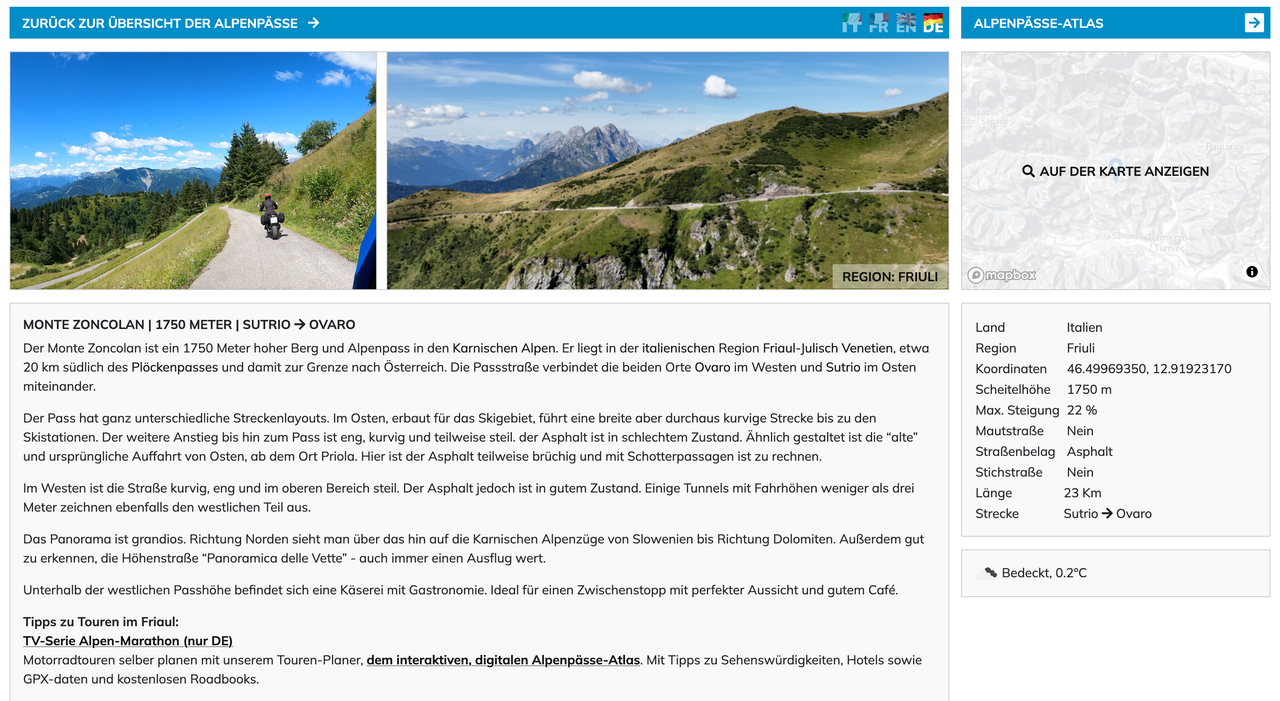
This is the case, for example, in the border area between Slovenia, Carinthia (Austria) and Friuli (Italy). Alpine passes such as the Passo del Cason di Lanza, Monte Zoncolan, Paulitsch Pass, Hochobir, Vrsic Pass, Passo Rest and several others have winding, narrow and steep sections.
Another example is the south-eastern foothills of the Alps, with Alpine passes sometimes below the 1000-metre mark. Nevertheless, it takes time to drive these routes. Example: Forcella di Pala Barzana or the Passo San Boldo.
• In addition to many individual cases in regions that are home to rather extensive Alpine passes, such as Les Martinaux in Valais, or the area around the Col de Turini in the French Maritime Alps, or the Colle d'Oggia, an example of Alpine passes in Liguria, there are also regions in the French Alps worth mentioning.
• French Alps, examples:
Some Alpine passes around the Saint-Maurienne valley are extremely time-consuming. Alpine passes such as Col du Sapey, Col du Chaussy or Col de la Confrérie offer a lot of fun on short stretches, but take a lot of time.
Another and final example is a region in the border area in the French Western Alps. Here, the Italian ramps of the border passes Col de la Lombarde and Col d'Agnel are worth mentioning. They are also steep, narrow, winding and therefore time-consuming. A little further south, located entirely in Italy, Piedmont, the Alpine passes Colle Fauniera, Colle d'Esischie and Colle di Sampeyre are worthy representatives of what can be understood in a positive sense as ‘time wasters’.
In very few cases does a navigation device take routes of this kind into account. The result is an extremely long day of motorcycling, which can also be exhausting.
High density of Alpine passes:
In some regions of the Alps, the Alpine passes are so close together that the route is either constantly uphill or downhill. Here, too, we have ‘learned’ in the truest sense of the word over the years that, with an average of 300 kilometres, no more than 10 Alpine passes should be planned. If narrow, tight and winding Alpine passes are also on the list of planned motorcycle tours, the driving time can quickly extend to 10 hours.
Typical examples are the Alpine passes in the Dolomites, regions in the border triangle of Friuli/Carinthia/Slovenia, but also in central Switzerland with Alpine passes such as the Oberalp Pass, St Gotthard Pass, Furka Pass, Grimsel Pass, Oberaar Panorama Road, Nufenen Pass ...
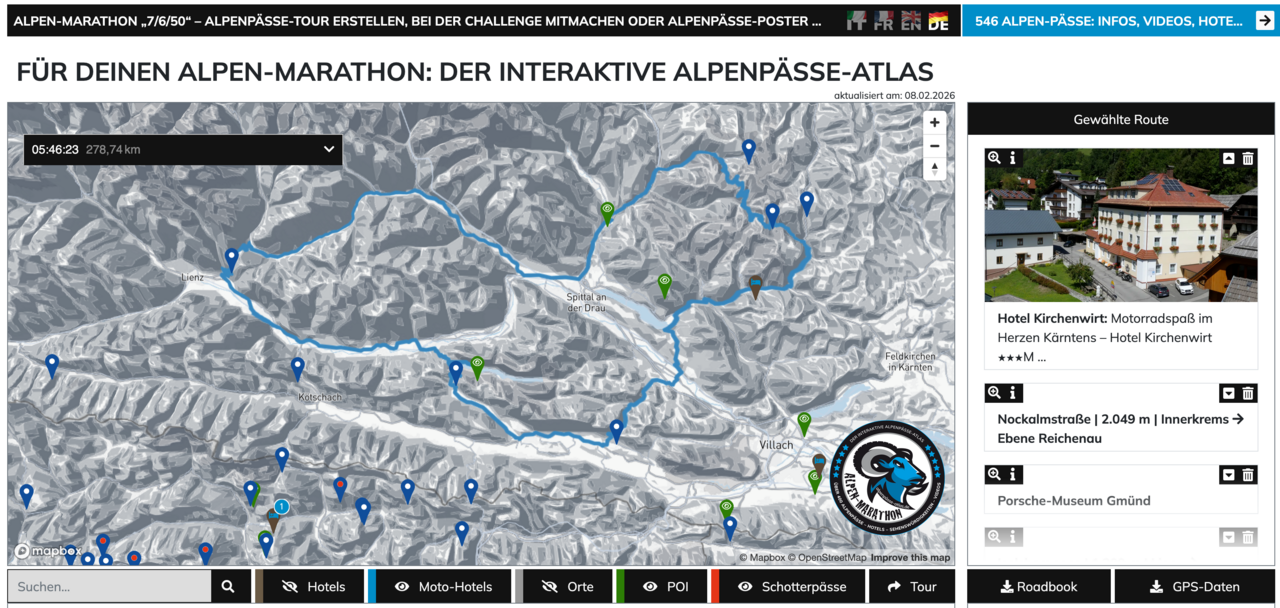
Further concentrated clusters of Alpine passes can be easily identified when planning your tour with our tour planner ‘Alpine Passes Atlas’.
Another factor that has a significant impact on the total time of your motorbike tour is traffic.
More than ever, traffic in large tourist regions of the Alps must be taken into account. In addition to motorcyclists, there are also many camper vans, which are becoming longer and longer, caravans, classic car drivers and, above all, the steadily increasing number of cyclists of all kinds, from e-bikes to mountain bikes to racing bikes. They all want to ride up and down the Alpine passes, albeit at different speeds. On public holidays and during holiday periods, there are also an extremely large number of motorists on the road. Italian motorists in particular like to take short trips to certain Alpine regions.
Italian public holidays, holiday periods and weekends mean long traffic jams even for motorcyclists, and not only on the access roads. The strongholds are the Dolomites, especially the Sella Ronda, as well as South Tyrolean Alpine passes along the Wine Route (Mendel Pass, Passo Tonale, etc.), through the Vinschgau Valley (Stelvio Pass, Reschen Pass, etc.), the Timmelsjoch, Jaufen Pass, Brenner Pass, etc.
In Lombardy, traffic jams are common in the Forcola di Livigno, Pass d'Eira and Passo di Foscagno areas.
In Switzerland, classic routes such as the Sankt Gotthard Pass, the Grimsel Pass, the Furka Pass, the Maloja Pass, the Splügen Pass and the San Bernardino Pass are prone to congestion.
Germany (Riedberg Pass) and Slovenia (Vrsic Pass, Mangart, Predil Pass, Loibl Pass, etc.) also have areas with heavy traffic. In Slovenia in particular, holiday traffic with camping vehicles has increased significantly in recent years.
And Austria offers panoramic roads such as the Grossglockner High Alpine Road and the Nockalm Road, which can cause traffic jams. But the Hahntennjoch, the old Brenner Road and the Fern Pass should also not necessarily be part of a motorbike tour on public holidays, holidays and weekends.
Unless you set off early, that is. Then almost every Alpine pass is free to drive on. And between sunrise and around 10 a.m., you can cover many kilometres. Another advantage: experiencing sunrise from an Alpine pass is a unique experience that will remain in your memory forever.
However, there are plenty of alternatives during these peak times that have little or no impact on travel times. In the south-western French Alps, there are more than two dozen Alpine passes, such as the Pas de la Graille, which offer plenty of driving pleasure and little traffic. The southern Slovenian and Italian Alpine passes are also among them. And, of course, part of the Western Alps, as there are a large number of Alpine passes to choose from, the ramps are mostly wide and spacious, and, due to the geographical location, there are generally fewer tourists on the road.
Vehicle, driving skills, physical condition, breaks and food are the basis for the average number of kilometres, time and Alpine passes indicated.
You will have to assess this yourself. However, we do have a few tips that may be helpful, especially if you have never been to the Alps before.
• Your vehicle must be able to maintain the average speed downhill as well as up the Alpine pass. Underpowered vehicles are a real ‘time waster’ in the Alps, with gradients of up to 18 degrees in some places. But you probably already know that.
• Your riding skills should not be limited to long straight stretches with occasional bends. The combination of inclines and bends, including tight hairpin bends, should be practised and mastered. That goes without saying.
• Otherwise, the next factor comes into play: your physical condition. Bends, inclines, downhill passages, braking and accelerating in constant alternation take their toll on your strength. This is especially true if you have little practice. Even experienced athletes underestimate how much strength is required in the arms, chest and back during 300-kilometre motorcycle tours with 10 Alpine passes. This makes you tired.
• Therefore, sufficient breaks are essential, especially on hot days. With sufficient wind, the sun's strength and effect are often not felt. The body dries out quickly, even though there is hardly any visible sweat.
• Food is also a factor. Above all, you should always take enough fluids with you – and always replenish them in good time. There are many regions in the Alps where there are no shops and therefore no petrol stations over long distances.
Drinking, preferably water, is extremely important. A common cause of accidents is dehydration, which often goes unnoticed because it is hard to imagine.
And now: Have fun planning your motorbike tour, preferably with our tour planner, the Alpine Pass Atlas.
For each Alpine pass, you will also find important information and facts about the pass, plus pictures, videos and daily updated weather conditions.
A rule of thumb – established by us, with many years of experience in the various Alpine regions – is that 300 kilometres is the average distance that can be covered in the Alps.
300 kilometres, assuming you are riding on asphalt, means about 7 hours, which is also the average riding time. This leaves a good two to three hours for breaks, especially drink breaks, and sightseeing.
What factors influence the average driving time in the Alps?
First and foremost, geographical factors have an impact on your daily destination.
Steep, narrow and winding Alpine passes:
• There are regions where the Alps only allow for narrow roads, steep gradients and small, tight bends.
For example, in the border area between Slovenia, Carinthia (Austria) and Friuli (Italy). Alpine passes such as the Passo del Cason di Lanza, Monte Zoncolan, Paulitsch Pass, Hochobir, Vrsic Pass, Passo Rest and several others have winding, narrow and steep passages.
Another example is the south-eastern foothills of the Alps, with Alpine passes sometimes below the 1000-metre mark. Nevertheless, it takes time to drive these routes. Example: Forcella di Pala Barzana or the Passo San Boldo.
• In addition to many individual cases in regions that are home to rather extensive Alpine passes, such as Les Martinaux in Valais, or the area around the Col de Turini in the French Maritime Alps, or the Colle d'Oggia, an example of Alpine passes in Liguria, there are also regions in the French Alps worth mentioning.
• French Alps, examples:
Some Alpine passes around the Saint-Maurienne valley are extremely time-consuming. Alpine passes such as Col du Sapey, Col du Chaussy or Col de la Confrérie offer a lot of fun on short stretches, but take a lot of time.
Another and final example is a region in the border area in the French Western Alps. Here, the Italian ramps of the border passes Col de la Lombarde and Col d'Agnel are worth mentioning. They are also steep, narrow, winding and therefore time-consuming. A little further south, located entirely in Italy, Piedmont, the Alpine passes Colle Fauniera, Colle d'Esischie and Colle di Sampeyre are worthy representatives of what can be understood in a positive sense as ‘time wasters’.
In very few cases does a navigation device take routes of this kind into account. The result is an extremely long day of motorcycling, which can also be exhausting.
High density of Alpine passes:
In some regions of the Alps, the Alpine passes are so close together that the route is either constantly uphill or downhill. Here, too, we have ‘learned’ in the truest sense of the word over the years that, with an average of 300 kilometres, no more than 10 Alpine passes should be planned. If narrow, tight and winding Alpine passes are also on the list of planned motorcycle tours, the driving time can quickly extend to 10 hours.
Typical examples are the Alpine passes in the Dolomites, regions in the border triangle of Friuli/Carinthia/Slovenia, but also in central Switzerland with Alpine passes such as the Oberalp Pass, St Gotthard Pass, Furka Pass, Grimsel Pass, Oberaar Panorama Road, Nufenen Pass ...
Further concentrated clusters of Alpine passes can be easily identified when planning your tour with our tour planner ‘Alpine Passes Atlas’.
 Subscribe to Newsletter